
How is the Irish Tech Recruitment Market Evolving in the first half of 2026?
What does this blog cover:
- The Post-Boom Hangover: The frantic, hyper-growth hiring sprees of the post-Covid era have officially given way to a highly calculated Irish tech market defined by strategic caution and a sector-wide headcount reduction of 21,000.
- The “Wait and See” Stance: Driven by escalating geopolitical tensions and macroeconomic ripples, employers are actively buffering their capital and shifting away from volume hiring toward strict, critical-hire-only patterns.
- The AI Productivity Pause: As generative and agentic AI tools rapidly mature, engineering leaders are realising their existing teams can do far more with less, prompting a deliberate pause on scaling team sizes.
- The Disappearing Junior Pipeline: This convergence of market caution and automation has triggered a short-sighted near-extinction of entry-level tech roles, quietly setting the stage for a major long-term talent crisis.
The Mid-Year Shift: Resilience Meets Strategic Caution
The Irish tech recruitment market in the first half of 2026 has transitioned from a steady post-2025 rhythm into a highly cautious, contract-heavy landscape. While overall employment remains stable, geopolitical tensions in the Middle East and rapid AI integration have prompted employers to pause volume hiring and we have seen a marked reduction in headcount across the tech sector in Ireland year over year (to the tune of 21,000 staff).
Following my Q1 2026 Tech Market Update, the second quarter of the year has introduced an extra layer of strategic calculation. The market isn’t in free fall, but the frantic hiring paces of the post Covid boom are officially behind us. Employers are facing a “wait and see” scenario driven by external economic factors, leading to highly specific, critical-hire-only patterns.
What the Data Says: CSO and ERF Market Barometers
Looking closely at the macroeconomic data helps us see where the market is pulling back and where it’s holding firm. The latest Central Statistics Office (CSO) Labour Force Survey (LFS) data from Q1 2026 highlights a definitive reduction in overall agency-engaged volume compared to late 2025:
Table 1: CSO LFS Agency Work & Total Employment Trends (2025-2026)
| Metric | 2026, Q1 | 2025, Q4 | 2025, Q3 | 2025,Q1 | |
Total Employment | 2.394m | 2.436m | 2.435m | 2.418m | |
Agency Work | 101.9k (4.26%) | 111.3k (4.57%) | 115.8k (4.75%) | 109.5k (4.53%) | |
Full-Time / Part-Time | 78.8k FT / 23.2k PT | 86.1k FT / 25.2k PT | 91.2k FT / 24.7k PT | 81.2k FT / 28.3k PT | |
Nationality Splits | 68.1k Irish / 33.8k Non | 73.7k Irish / 37.6k Non | 75.5k Irish / 40.3k Non | 72.7k Irish / 36.8k Non |
Overall, the LFS numbers reveal a decline of 9,400 agency workers in Q1 2026 relative to Q4 2025. This downward pressure mirrors what we are actively experiencing on the ground heading into the end of Q2.
The Recruitment Sector View: Sentiment vs. Action

Data collected through the Employment & Recruitment Federation (ERF) and Ipsos B&A Monthly Monitors from May and June 2026 sheds light on how recruitment agencies are navigating this climate. While permanent vacancies saw a brief, localised stabilisation in late spring, the forward-looking sentiment continues to contract. This data spans all sectors of the economy, not just tech.
Key June Monitor Highlights (Reflecting May Activity):
- The Permanent Slowdown: By May, only 35% of surveyed recruitment businesses reported an increase in permanent vacancies, while 29% noted a strict downturn.
- Contractor Reliance: As employer confidence wavers due to wider economic risks, companies are utilising temporary and contracting solutions to manage permanent headcount risks. For instance, 36% of agencies reported an uptick in temporary placements in May.
- Declining Client Acquisition: Reflecting an enterprise-wide tightening of budgets, the percentage of recruitment businesses onboarding brand-new clients dropped to 64% by the end of Q1 and sat at 45% of agencies securing 1–2 new clients in the updated May figures.
- Salary Equilibrium: Rates of pay have hit a plateau. Roughly 72% of permanent roles and 85% of contract roles reported completely flat salary ranges compared to previous months, indicating that the era of aggressive wage-bidding has cooled.
The View from the Ground: GemPool’s Anecdotal Insights
At GemPool, we have felt these macro trends manifest as specific behavioural shifts within tech teams across Dublin and the wider Irish market. Two primary factors are driving the current wave of enterprise caution:
- Geopolitical and Energy Pressures: The ongoing crisis in the Middle East (specifically the Iran war) has spiked domestic fuel protests and introduced worries regarding energy security and inflation. Multinational tech hubs are choosing to buffer their capital rather than open up expansive project headcount.
- The AI Hiring Pause: In our everyday conversations with engineering leaders, we are hearing a distinct subtext of AI-driven hesitation. Companies are actively evaluating whether emerging generative AI and automation tools can cover current workflow gaps. Instead of hiring a new developer to scale a service, leadership teams are pausing to see if their existing senior team, backed by agentic AI tools, can handle the lifting. From talking to CTO’s extensively, through our CTO Community, we are seeing a genuine step change in productivity and capability of these tools, that is allowing companies to do a lot more with the same headcount, or less headcount.
- Big-tech bloat reductions: Another widely discussed trend is the large tech companies reductions in headcount reflecting a rightsizing of their teams after the bloat created post Covid. This continues but will be less prevalent in the second half of 2026, in my view.
A Short-Sighted Trend: The Graduate & Entry-Level Deficit
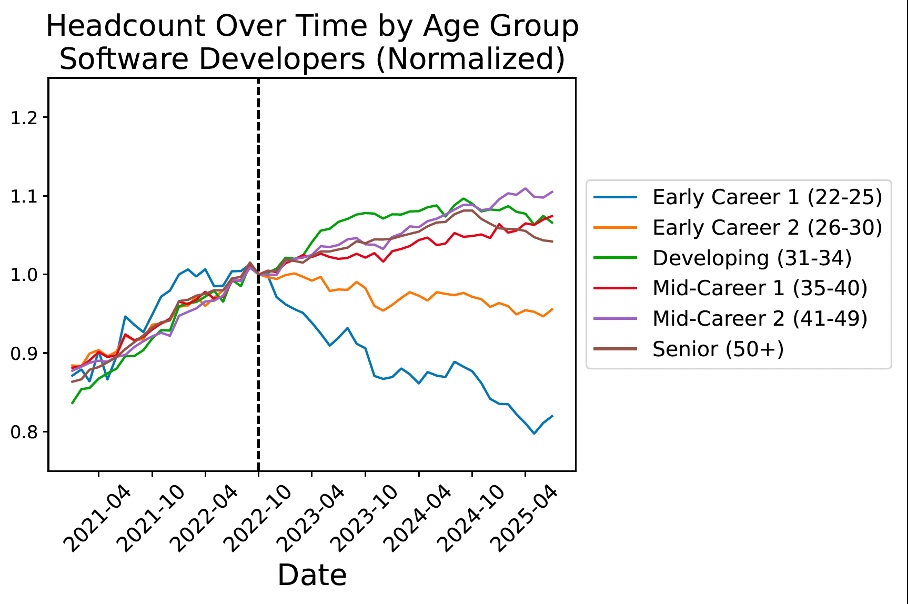
The convergence of AI efficiency and market caution has triggered a secondary crisis that I believe is highly short-sighted: the near-disappearance of entry-level and graduate software engineering roles. I am getting introduced to people’s kids or nephews or nieces a lot more than I normally do, as they are struggling to find work and they are trying every avenue possible to get into a role.
We are watching companies eliminate their junior pipelines under the assumption that AI tools completely negate the need for foundational staff. This mimics a prominent trend that has already disrupted tech sectors in the US market, which can be seen from the graph below. (source)
Why this creates a long-term problem:
- The Senior Talent Drought: Eliminating junior hires today ensures there will be no homegrown mid-level talent tomorrow.
- The Context Gap: AI can write boilerplate code, but it cannot understand your proprietary software architecture, corporate infrastructure, or team culture.
- Overburdened Seniors: Without junior engineers to handle foundational support tasks, senior developers spend valuable time on lower-tier tasks, accelerating burnout.
Navigating H1 2026: Next Steps for Hiring Managers

To remain competitive as we look toward the latter half of 2026, tech leaders must look past immediate cost-cutting and focus on sustainable team health.
If you want to ensure your technical infrastructure is resilient for the remainder of 2026, consider these strategic steps:
- Leverage Strategic Contracting: Use contract talent to bridge critical skill gaps in specialised domains like regulatory compliance (DORA/NIS2) or specialised ML pipelines without inflating permanent employee costs.
- Protect Your Junior Pipeline: Maintain a modest, deliberate entry-level intake. Educating the next generation of engineers on how to use AI productively within your unique tech stack is a massive competitive advantage.
For tailored insights on navigating your tech team’s hiring roadmap or structure, reach out directly to us.
FAQs on the Irish tech recruitment market in 2026:
A: Driven by geopolitical uncertainty and post-Covid rightsizing, employers are adopting a “wait and see” approach to mitigate permanent headcount risks. Rather than pausing projects entirely, companies are leaning heavily into contract talent to bridge critical skill gaps without inflating long-term payroll costs.
A: Generative and agentic AI tools have significantly boosted senior developer productivity, leading many CTOs to pause volume hiring under the assumption that automation can cover foundational workflow gaps. However, this has created a short-sighted near-extinction of graduate and junior software engineering roles, which threatens to cause a severe homegrown mid-level talent drought and accelerate senior burnout in the coming years.
If you’re looking to figure out the best recruitment plan for your company, explore our services today.